
Roger Washington: Your current exhibition, Traces of a System, explores what remains after systems have changed, been concealed, or been given the possibility to change. How does this concept relate to the position you want to take as an artist today?
Marinda Vandenheede: My work begins with objects that have already lived, such as a punch card from a weaving loom, or a yellowed page torn from a book. They once belonged to something larger, but that entity is gone. The punch card no longer instructs a machine. The page is no longer read by anyone.
That is where I work from. Not from an image I decide in advance, but by looking, gathering, shifting and leaving out until something remains that feels right. What is visible never tells the whole story. Often the meaning lies in what has fallen silent.
I do not explain it. I set the page down and ask myself what it still says now that no one reads it.

Marinda Vandenheede, Endymion II, 2025, Ink and pencil on reclaimed book pages, 17.5 x 24 cm. 6 7/8 x 9 1/2 in.
RW: When you compare how you worked earlier in your career with the decisions you make today, can you explain how you hold on to older ideas while at the same time developing new ones?
MV: My work has changed, but certain questions keep returning. I do not preserve old ideas, I run into them again. Seen from another time, they say something different.
I used to want to control an image until it was right. Now I leave more to what happens while I work. A tear, a stain, a surface that will not be steered. The old ideas do not disappear, they change shape. Sometimes I only understand years later why one of them had stayed with me.
So I do not make something new for the sake of the new. I simply ask the same question again: what do I see this time that I did not see then?

Marinda Vandenheede, Illegible, 2026, Ink on reclaimed book pages from 1889, 44 x 30 cm. 17 3/8 x 11 3/4 in.
RW: You trained in graphic design before developing your own artistic practice. What did that training teach you about the way you look and build an image? And what did you later begin to question or leave behind as your own visual language developed?
MV: My training in graphic design taught me to look at proportion, rhythm, and what happens in the space between two elements. I learned to build an image and to steer it.
Later I began to distrust that steering. An image can also arise from something you do not fix in advance. Intuition became more important, not as randomness but as a way of looking that comes from experience. I still start from composition, but I leave a margin for what I could not have thought up.
Usually that is exactly the part I feel something in. I learned how to make an image. After that I learned to trust what cannot be made.

Marinda Vandenheede, Breathing Rooms 3, 2022, Acrylic paint, reclaimed industrial punch cards, thread, on hand soldered copper frame, 25 x 37 x 14 cm. 9 7/8 x 14 5/8 x 5 1/2 in.
RW: When viewers encounter your work without knowing the full history of the materials, texts, or objects you use, what information do you consider essential for them to know, and what aspects of the work do you want them to interpret for themselves?
MV: The materials carry their history with them before I begin. Old book pages, industrial punch cards, a found object. They have lived, and their wear is not a flaw to be repaired. It is information.
I do make some things. The small copper frames around the cards I solder to measure, by hand, one by one. But I reach for old and slow techniques on purpose, so that what I make carries the same time as what I find. The making and the finding meet in the same hand.
A viewer does not need to know much more than that. That every material reaches me with a past, and that every intervention shifts the relation between what was there and what remains.
The rest is theirs. I do not want them to understand the work. I want them to feel the slight discomfort of almost understanding, the moment just before something falls into place and then does not. That is where the work stays alive the longest.
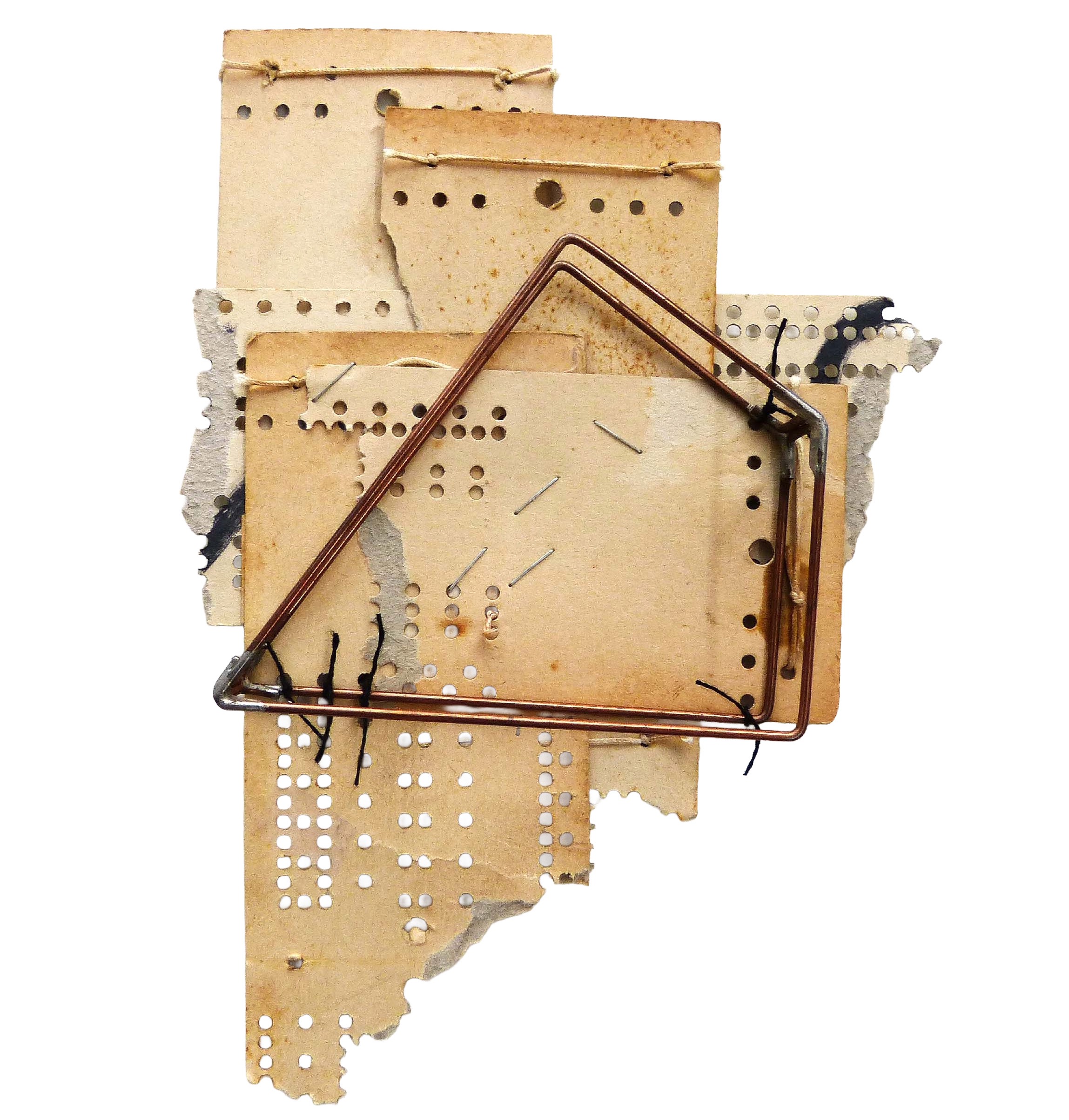
Marinda Vandenheede, Breathing Rooms 8, 2026, Acrylic paint, reclaimed industrial punch cards, thread, on hand soldered copper frame, 23 x 17 x 3 cm. 9 x 6 3/4 x 1 1/8 in.
RW: Traces of a System places older and current works in direct dialogue. When you compare them now, which ideas have remained central to your current practice, and how do they define your artistic position as you consider future work?
MV: One tension runs through everything I make, and it has grown sharper over the years. The one between use and memory, between presence and what is no longer there. It was there before too, but I had no words for it. I worked by feel, with a worn surface, a thing that had lost its function.
What has stayed is that single moment when an object comes loose from what it served and begins to carry something else. A punch card was an instruction for a loom. A printed page was written to be read. Now the card directs nothing and the page is looked at rather than read. Both have quietly stopped doing what they were made for. That I leave them that way is not indifference, it is a position.
For new work I am drawn to the line between leaving out and adding. I keep taking more away. The question that occupies me is how far I can go before nothing is left, and whether the work is waiting exactly there.

Marinda Vandenheede, Writer’s Block, 2023, Metal rod, a feather, on reclaimed wood, 11 x 26 x 7.5 cm. 4 3/8 x 10 1/4 x 3 in.
RW: What do you want viewers to understand about your artistic position through this exhibition beyond the individual works themselves?
MV: What I want to leave with people is not a message but a way of looking. I work against the current of everything that has to be legible and shareable at once. I try to make a moment of slowness, an invitation to look not only at what a thing is, but at what it has been through.
This exhibition is not about the individual objects. It is about what sits behind and between and beneath things, the connections that do not show themselves right away. Between people and objects, between memory and matter, between what once worked and what is left of it.
Someone who leaves feeling a little more connected afterwards, to the work, to themselves, to what came before, to one another, that is what I do it for. Standing still is not going backwards. It is learning to look again.
Interview conducted by Roger Washington
DOCUMENTS |LINKS
Related artist

About the author
