
Profile pic: Andrae Green. Image: @Artist
Jamaican artist Andrae Green's online solo exhibition, The Arrested Movement: Paintings of Time, Memory, and Perspective which opened in our gallery's online viewing room and on Artsy on June 12, 2026. The exhibition runs until August 15, 2026.
Growing up in Kingston, Jamaica, my childhood was shaped by faith, family, comics, economic instability, and political tension. — Andrae Green
Roger Washington: Memory, spirituality, personal history, and imagined space all move through your paintings simultaneously. How do you navigate the relationship between lived experience and invention when developing a work, and where do you see that balance most clearly in your recent paintings?
Andrae Green: To understand how I navigate that space, you have to understand that I do not see memory as a static photograph. I experience it as something active and constantly being reconstructed, almost like an image that is being revised while I am still looking at it. Everything feels familiar, but the elements keep shifting. I was watching a television show recently, and one line stayed with me because it expressed this feeling so clearly: “We trust that time is linear. That it proceeds eternally, uniformly. Into infinity. But the distinction between past, present and future is nothing but an illusion. Yesterday, today and tomorrow are not consecutive, they are connected in a never-ending circle. Everything is connected.”
Growing up in Kingston, Jamaica, my childhood was shaped by faith, family, comics, economic instability, and political tension. My father was a pastor, and our whole family was deeply involved in the church, so spirituality was not separate from everyday life. When I step up to a canvas, I am not trying to document those early experiences as cold historical facts. Lived experience gives the work its anchor: the physical sensation of being in Kingston, standing by the harbor, feeling the salty breeze, the heat of the sun, and the specific posture of my father standing beside me. Invention is how I let those memories move beyond my own life and become something other people can enter.

Andrae Green, Pool Boy V - Memories of Tomorrow, 2026, Oil and acrylic on canvas, 35.6 x 27.9 cm. 14 x 11 in.
My paintings sit between what I remember and what I imagine, and they look at how identity is always being shaped rather than fixed in one place. The people I paint may function as archetypes, but they are still fully human. I am trying to articulate what it means to be human, fully human, flawed, and divine at the same time.
You can see this balance incredibly clearly in the works I am currently showing at Ronewa Art Projects, specifically in Pool Boy V - Memories of Tomorrow, 2026. The figure in that piece is not only a portrait of a specific person. He also carries a whole inner world, where memory, desire, history, and lived experience all press against one another. The environment around the figure is invented, but the emotional weight pulling on him is entirely real. The invention happens on the surface, where the physical reality of the paint meets the intangible nature of my personal history.
RW: Growing up in Kingston, Jamaica, comics became an early point of entry into visual storytelling before you entered formal art education. How have those early influences continued to shape the way you approach narrative, movement, and tension within the work today?
AG: Comics were an absolute refuge for me as a young boy in Jamaica. Long before I had the vocabulary of art history, philosophy, or postcolonial theory, comic books and science fiction taught me the basic structure of how images tell stories. I can still remember spending hours on the cool tile floor, completely lost in Spider-Man’s latest adventure, and then pulling out my sketchbook to draw the most powerful poses I could imagine. Comics showed me that a single, static image could hold immense kinetic energy and suggest a much larger narrative arc.
Today, that early influence continues to shape how I construct tension on the canvas. I did not fully realize this until recently, when a friend pointed out that my background in comics also informs the way I build panels within my paintings. In a graphic novel, each panel functions as an individual frame that captures a single moment in time or action, while the blank spaces between those panels, the gutters, become just as important. In more dynamic comics, the relationship between panels and gutters is used to break space open, guide the viewer’s eye, and draw them deeper into the story.
For me, that same logic carries into the work. I started using panels, and the shape and structure of those panels, as a way to think through my interest in quantum physics: the possibility that multiple events can exist at once, branching outward into different forms, times, and possibilities, almost like a fractal. The panels become a way of building time into the painting, while their formal presence still reaches back to my earliest experiences with comics. Illustrators have used these tools for a long time to create movement and sustain attention, and in many ways, I am doing something similar within painting.
Before I went to undergrad, I was completely set on becoming an illustrator. At that time, illustration was the only artistic language I truly knew. It is fascinating now to see how those early influences continue to resurface and bleed back into my practice in ways that feel both intentional and intuitive.
In comics, the most critical moments often happen in the gutter, that blank space between panels where the reader’s imagination steps in and completes the action. I approach my paintings in a similar way. I am far less interested in showing the resolution of an event. I am drawn instead to the threshold, the liminal space just before a leap is taken or a transformation occurs.
This idea sits at the core of my Ronewa exhibition, The Arrested Movement. The figures exist in a state of suspension, caught in a moment of stillness that still holds potential energy. The dissonance of color creates psychological depth, asking the viewer to remain inside that tension rather than rushing toward resolution or conclusion.
RW: The figure of the “Diver” appears throughout your practice as both a physical and symbolic form. What does that image represent for you at this stage in your life and practice, and how has its meaning evolved over time?
AG: The Divers series sits at the very center of my current work, and it is deeply personal. The origin of the image is very specific: it comes from a childhood memory of standing at the edge of Kingston Harbor with my father, watching young boys leap fearlessly into the sea. In its earliest form, the diving figure represented physical courage and the exuberance of youth.
Over time, and especially after the passing of my father and the birth of my own son, that meaning deepened. As I have continued to grow into the series and push further into the work, the diver has transformed. It has become a stand-in for me, my father, and my son.
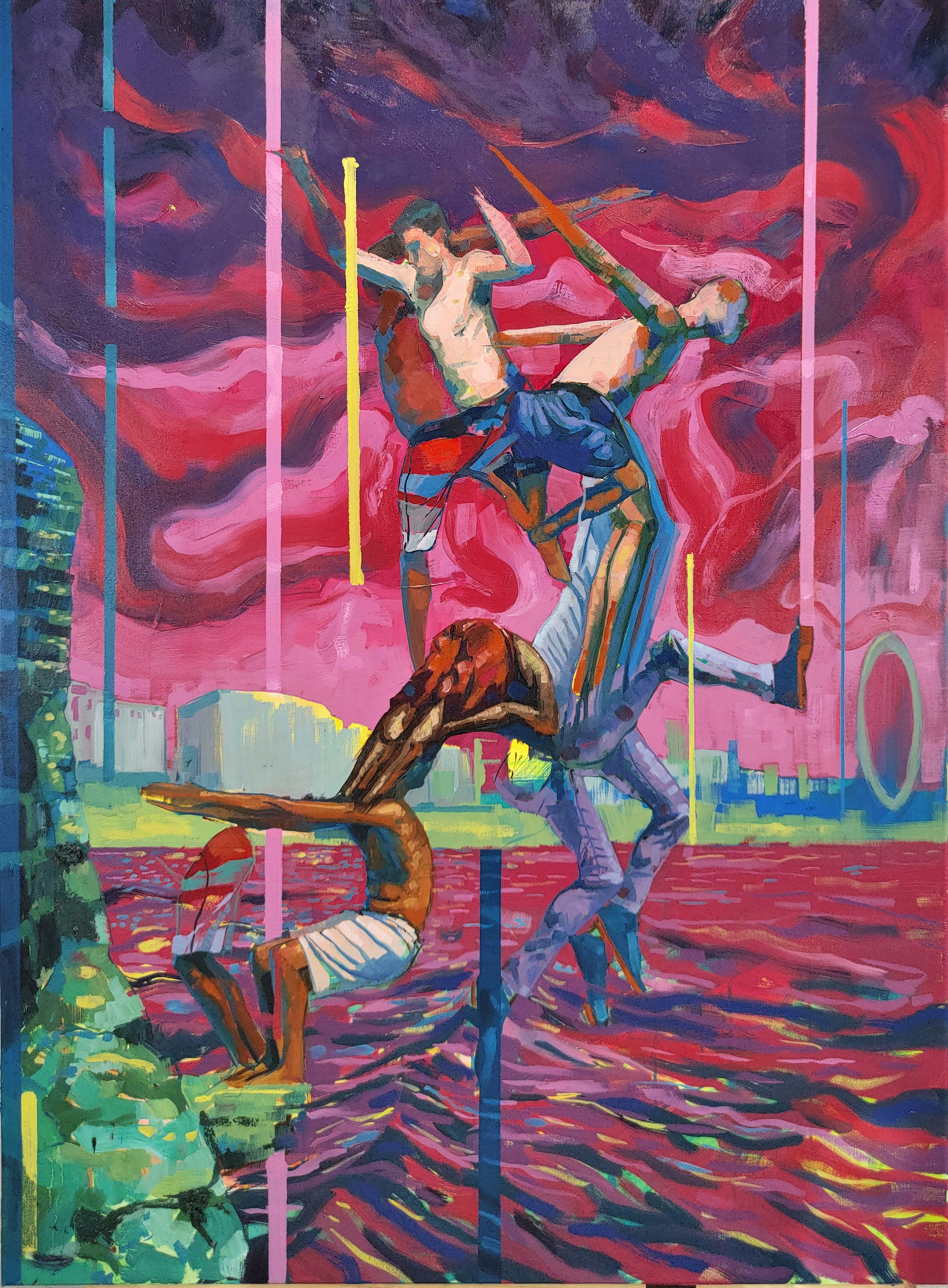
Andrae Green, Divers IV, 2021, Oil and acrylic on canvas, Oil and acrylic on canvas, 121.9 x 91.4 cm. 48 x 36 in.
What began as a singular image has evolved into an imagined intergenerational conversation between my father, myself, and my son. The figure now carries the weight of what is passed between generations: wisdom, fear, love, expectations, dreams, and even unresolved questions that linger across time.
When you look at these paintings now, the age of the figure begins to shape the narrative. When the diver appears as a middle-aged man, the figure is rooted in my own experience. It reflects the aspirational parts of my life, the moments when I am pushing forward and trying to become everything I am capable of becoming. When the figure shifts into a boy, a teenager, or an adolescent, the focus turns toward my son. In those moments, the image holds my hopes and aspirations for him, while also carrying the deeper, unresolved questions that come with being a parent: Who will he become? How will he find his way?
Ultimately, the diving figure operates as a placeholder for a much larger, ongoing dialogue between the three of us; my father, myself, and my son. Engaging with this dynamic has made me realize that life repeats itself more than we sometimes want to admit. Time does not feel strictly linear. Instead, it reveals itself as something circular, where the same emotional, psychological, and existential pressures reappear across generations. The very experiences I am navigating now are, in many ways, reflections of what my father once lived through, and what my son will eventually encounter for himself.
There is a profound depth to this circular understanding of life, one that resonates strongly with what I recognize as a fundamentally African worldview. Although I was raised within a Christian framework, and that faith still deeply informs how I understand the world. It moves me to see how these foundational cultural beliefs and ancestral rhythms continue to persist. Even when you are far removed from your original context, those patterns remain alive and active within you.
The diver exists within that continuous loop of inheritance. He represents each of us standing at the edge of transformation, suspended between past, present, and future, navigating all three at once. There is always that singular moment in the act of diving when your feet leave solid ground, but you have not yet broken the surface of the water. You are completely surrendered to gravity and to the unknown.
In works like Divers IV (2021), the diving figure ultimately becomes a universal image. It stands in for anyone positioned at the threshold of change. It has become my central metaphor for faith, vulnerability, and risk.
RW: Many of the paintings examine Black manhood through vulnerability, responsibility, reflection, and transformation rather than fixed stereotypes. What questions are you working through when depicting the Black male figure, and how do those ideas shape the emotional and psychological space of the paintings?
When I depict the Black male figure, I am continually asking: what does it mean to be fully human, and to be allowed vulnerability, within a society that so often demands a hardened exterior? My Jamaican roots, along with my understanding of the postcolonial condition, profoundly shape this inquiry. They push me to examine the hybrid identities we are constantly negotiating in our daily lives.
Two books that deeply transformed my worldview and gave me critical insight into this duality are Frantz Fanon’s Black Skin, White Masks and Ralph Ellison’s Invisible Man. Both texts introduced me to the idea that, as a Black man, there is an inherent duality to one’s existence, a kind of “double consciousness,” where you are constantly navigating how you see yourself and how the world chooses to see you.

Andrae Green, Pool Girls III, 2026, Oil and acrylic on canvas, 121.9 x 91.4 cm. 48 x 36 in.
Within my practice, I am actively working through questions surrounding human dignity, hope, the complexities of fatherhood, and, at the core of it all, what it truly means to be human. I am interested in stripping away the cultural expectations and fixed stereotypes that attempt to reduce Black men into monolithic, one-dimensional constructs.
Instead, I place my figures within quiet, contemplative spaces. You can see this most clearly in the Pool Boy series, where the figures are not performing for an external audience, but are instead engaged in their own emotional and psychological landscapes. The work becomes an exercise in introspection, a turning inward, where the figure exists within an internal sanctuary.
In this way, these figures operate as archetypes of resilience. They carry the weight of history, while also remaining in search of grace, belonging, and meaning.
RW: A strong sense of suspension exists throughout the work, as though the viewer is witnessing a moment between memory, dream, and reality. How do you construct these “arrested moments,” and what role do ambiguity and uncertainty play within your visual language?
AG: Those “arrested moments” are constructed primarily through a deep commitment to materiality. I place great importance on the physical surface of the painting. Paint should feel physical, embodied, and alive. I use collage, thick impasto, scraping, and raw areas because the surface itself needs to become a record of accumulation, excavation, and decision-making. The works embody the same tensions they investigate conceptually.
Conceptually, that sense of suspension is also connected to Expressionism, Surrealism, and Cubism. I use those frameworks to anchor the picture and extend the ideas I am working through. At its core, Cubism is concerned with representing more than one point of view at once, and for me that opens up a way to think about time, space, and memory as things that are never static. They are always evolving, moving, and changing. The question becomes: how do you represent that constant flux on a two-dimensional surface? In some way, you have to break the picture plane.
Surrealism, on the other hand, gives me part of my visual language. I am constantly riffing on the language developed by artists I consider heroes, including Neo Rauch, Ruprecht von Kaufmann, Salvador Dalí, and my mentor, Vincent Desiderio. I also draw heavily from the Expressionist force of Francis Bacon and Robert Rauschenberg. I use that vocabulary as a starting point, but I am always trying to shape it into my own sense of the world I am building.
That is why the spaces my figures inhabit can feel familiar at first glance, but become stranger the longer you look at them. I want that sense of familiarity to be deeply embedded in the work, almost like déjà vu.
Because of this, ambiguity in my work is not a lack of clarity. It is intentional. We live in an age where digital technology and artificial intelligence often demand certainty, synthetic perfection, and immediate answers. Painting offers a necessary counterpoint because its slowness preserves human doubt and wonder. For me, uncertainty is the space where faith operates. My Christian worldview informs this deeply. I am interested in those quiet, unresolved moments where the ordinary and the sacred coexist. The suspension you see in the work is an invitation for the viewer to step into that uncertainty, pause, and reconsider their own relationship to the world.
RW: Question 6: Technical precision and philosophical inquiry operate closely together throughout your practice. Looking at the current body of work, what do you believe it reveals about your position as an artist today, and where do you see the work moving next?
AG: Looking at my current body of work, especially the pieces featured in The Arrested Movement, I believe it reveals an artist who completely rejects the narrative that painting is obsolete. As an educator and a painter, I view both roles as a form of cultural stewardship. We are living through an era of profound technological acceleration, and my position is that art remains one of the oldest ways we have of carrying meaning from one generation to the next. The work reveals my enduring belief that hope is, quite literally, the best defense against dystopia.

Andrae Green, Divers XII - Ascension II, 2026, Oil and acrylic on canvas, 91.4 x 61 cm. 36 x 24 in.
As for where the work is moving next, a growing area of my practice is investigating the relationship between painting and emerging technologies. I am increasingly interested in placing the rich, slow materiality of painting into a direct dialogue with our algorithmic society. I want to explore what becomes of memory when images are increasingly detached from lived experience. I see my future work diving deeper into these themes of technological mediation while fiercely guarding what still feels deeply human. My ultimate goal is to continue creating images that hold memory, challenge our perceptions, and preserve a space for human wonder.

Add a comment