
Profile image: Saša Pančić
Saša Pančić
Semantic Shadows
MSUB Museum of Contemporary Art, Belgrade, Serbia | Gallery-legacy of Milica Zorić and Rodoljub Čolaković
Interview by Nikola Marković
Originally published in Politika, Cultural Supplement, December 20, 2025.
Saša Pančić’s artistic practice unfolds through abstraction, material presence, and spatial perception. His exhibition Semantic Shadows presents a comprehensive overview of more than two decades of work, including sculptures, objects, drawings, and video works, with a particular focus on his most recent production. Curated by Dr. Rajka Bošković and Miroslav Karić, the exhibition examines Pančić’s sustained investigation into the relationship between material and immaterial space.
For Pančić, every artwork carries an intention to address the viewer. Once completed and released from the artist, the work enters an unpredictable encounter with the observer. He maintains a deliberate distance from interpretative frameworks shaped primarily by social or temporal conditions, favoring instead the individual’s direct encounter with the ontological elements of reality. This encounter—experience itself—becomes the starting point for understanding.

Installation view, Semantic Shadows, MSUB Museum of Contemporary Art, Belgrade, Serbia | Gallery-legacy of Milica Zorić and Rodoljub Čolaković. Photo: Saša Pančić, 2025.
The notion of “semantics” in Pančić’s work is not narrative but experiential. Through abstraction, stripped of storytelling, he seeks a universal meaning of space. His approach aligns closely with the principles of concrete art, in which the artwork is not a mediator but a direct presence. For this reason, Pančić often refers to his works not as objects, but as subjects.
The concept of the shadow plays a central role in his semantic system. Shadows point to the paradoxical nature of light and its hidden function as a bridge between the immaterial and the material worlds. Drawing on references ranging from Kazimir Malevich’s Black Square to Byzantine icons and ancient Egyptian reliefs, Pančić understands the shadow not as a byproduct of the object, but as an active force that delineates space. In this sense, shadow holds equal—if not primary value to steel itself, as it renders latent spatial events perceptible.
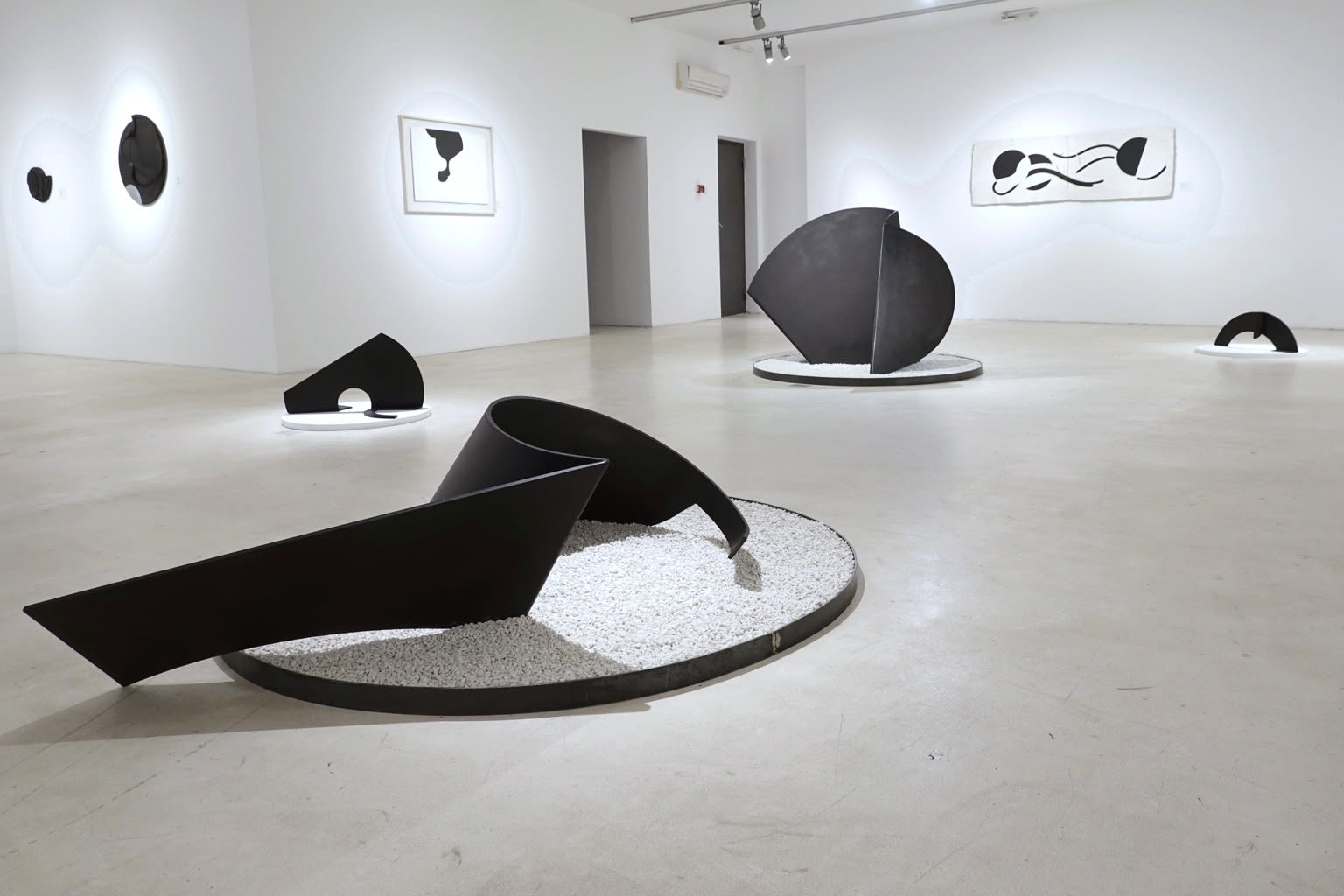
Installation view, Semantic Shadows, MSUB Museum of Contemporary Art, Belgrade, Serbia | Gallery-legacy of Milica Zorić and Rodoljub Čolaković. Photo: Saša Pančić, 2025.
Pančić’s thinking resonates with philosophical reflections on space found in both Eastern and Western traditions. While Vedic doctrines and Taoism inform his outlook, his artistic reference points remain Malevich’s Black Square and Constantin Brâncuși’s Endless Column. Across architecture and sculpture—from the Temple of Hatshepsut and Peter Zumthor’s thermal baths to the works of Tatlin, Richard Serra, and Eduardo Chillida—Pančić identifies a shared concern with the human body’s relationship to space and the extra-historical dimension of movement.
Material choice is integral to this inquiry. Beginning with the transformation of two-dimensional space into objecthood, Pančić works primarily with planar materials—paper, rubber, sheet metal, steel, corten, and stainless steel. Meaning emerges through transformation rather than being imposed in advance. In his semantic field, shadow and steel are equivalent forces.
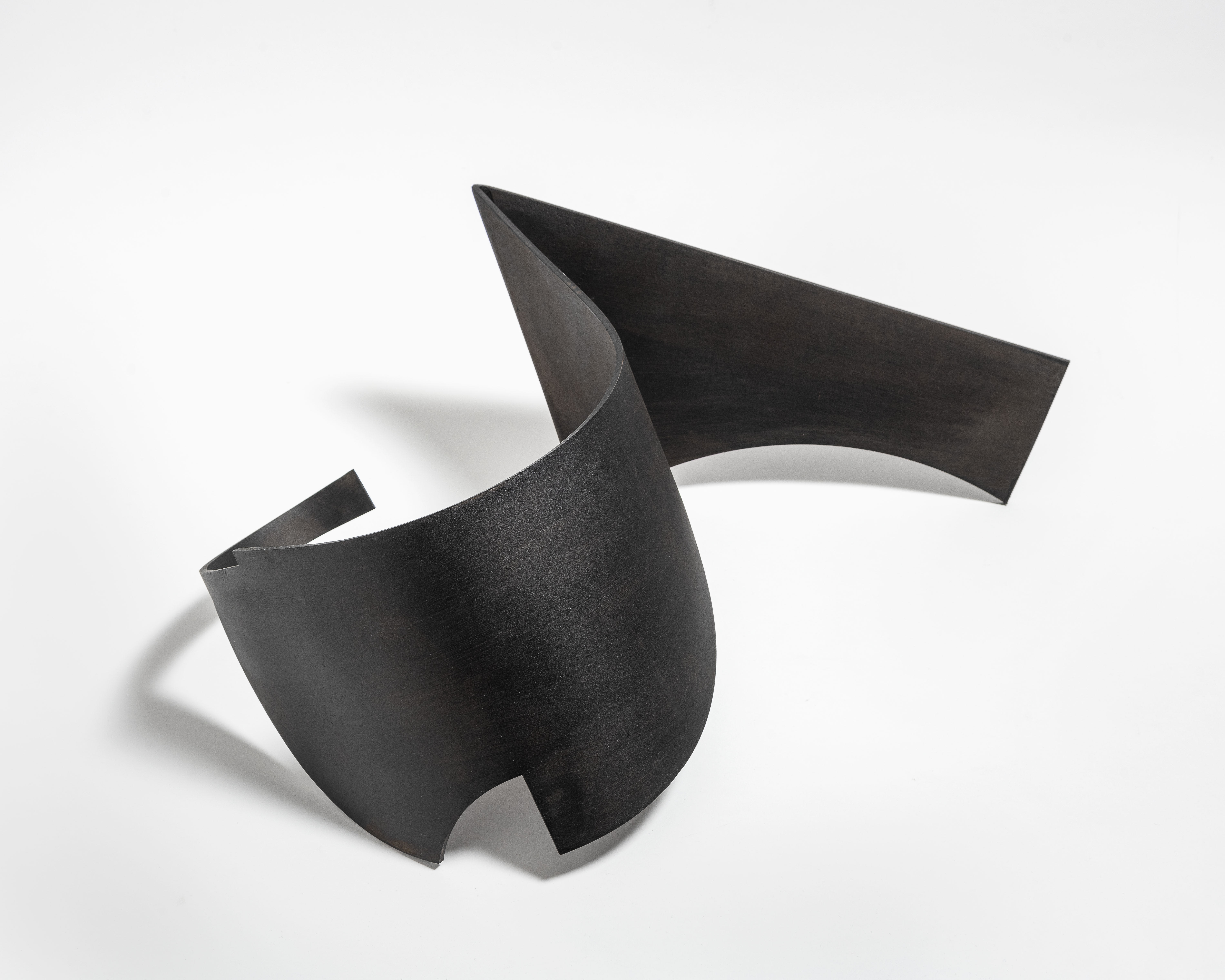
Installation view, Semantic Shadows, MSUB Museum of Contemporary Art, Belgrade, Serbia | Gallery-legacy of Milica Zorić and Rodoljub Čolaković. Photo: Saša Pančić, 2025.
Color functions as sensation and emotional manifestation, while the disciplined relationship between black and white brings Pančić closer to structure. This reduction aligns with the principle “less is more,” reinforcing a path toward what he describes as a higher reality.
A decisive moment in Pančić’s development occurred in 2006, when he first exhibited works that extended surface into free space. The conceptual, material, and monochromatic framework established then continues to shape his practice, not as a limitation but as a liberating structure. Belonging to a generation that spans analog and digital technologies, Pančić employs contemporary tools—photography, laser, video—while remaining critically aware of algorithmic systems and the unreflective use of artificial intelligence. He ultimately affirms the enduring value of direct, unmediated human experience, elevated to a universal level, an experience that art continues to safeguard.
Ronewa Art Projects is pleased to present Semantic Shadows, an exhibition by Saša Pančić, currently on view at the MSUB Museum of Contemporary Art, Belgrade, Serbia | Gallery-legacy of Milica Zorić and Rodoljub Čolaković
Building on this exhibition, Ronewa Art Projects will host a private selection of works by Saša Pančić in our online viewing room and on Artsy from February 12, 2026 to March 26, 2026.

Add a comment